Inclusion at the heart of every question you ask.
Supporting the key people in settings with the knowledge, skills and advice to help every child be included and have the best start in life — and to help them and those who support them achieve the extraordinary, everyday.
These guides are in English. To translate a downloaded guide, use Google Translate's document translation at translate.google.com.
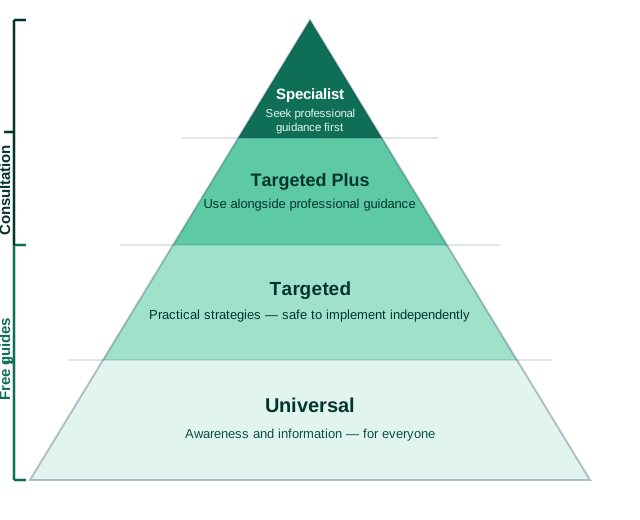
Targeted Plus guides cover strategies that work best alongside specialist advisory input — someone who can help you tailor the approach to your specific cohort and context. Specialist guides describe statutory processes where professional guidance is essential from the outset. A settings enquiry is the right starting point if you're not sure where your need sits.
These guides are designed to support the confidence and understanding of your team, highlight common misconceptions or mistakes so they don't make them — and, as the Equality Act's anticipatory duty requires (reflected throughout the SEND Code of Practice), help you be ready for a child with SEND before they start at your setting. Get in touch to find out more.
Every guide above can be read on this page and saved as a PDF from it. Fillable templates to download: ISP template (Word) · One Page Profile template (Word) · One Page Profile template (PDF)

What separates a genuinely useful plan from a box-ticking exercise. Read the guide · free PDF & template

Co-producing the review, using the Four Cornerstones. Read the guide · free PDF

Transition as a bridge, not an event — building one that carries every child. Read the guide · free PDF

Building a plan that staff can actually follow under pressure.

Practical priorities when needs across a group vary widely.

Co-produced with families — strengths, communication, reasonable adjustments. Read the guide · free PDF & template

What to look for, room by room, beyond the policy document.

Making circle time and group activities work for every child.

Understanding function, proactive strategies, and what to do in the moment. Read the guide · free PDF

Why key-person relationships matter, and how to protect them.

Helping all children understand and respect personal and social boundaries as part of everyday inclusive practice.

Practical approaches to mealtimes that work for all children, including those with sensory or feeding needs.

Moving from consultation to genuine shared decision-making.

How these meetings actually run, and how to prepare for one.

Making supervision a genuinely useful space, not just a box to tick.

What to look for when choosing specialists and associates to work with.

The steps involved, and what to get right at each stage.

Producing advice that's genuinely useful to the panel reading it.

Running a review that's thorough without becoming a formality.

What to consider so the policy reflects what actually happens.

A plain-English answer, and where the line genuinely sits.

The key documents that matter, summarised without the legal density.
Practical guidance on the operational and leadership responsibilities that sit alongside day-to-day inclusive practice — from policy writing and data recording to inspection readiness and staff wellbeing.

What a genuinely useful progress review looks at, and how often.

Building inclusion into your improvement plan so it's embedded, not bolted on.

What to record, how to use it, and meeting your GDPR obligations in the process.

Practical approaches to eco-awareness and green practice that work alongside inclusive provision.

Risk assessment, care plans and emergency procedures that work for all children.

Responding well when families raise concerns — process, tone, and resolution.

Knowing what's available locally and how to connect families to the right support.

What inspectors look for, what evidence matters, and how to talk confidently about your provision.
Guidance written for the governance role specifically — what to ask, what to look at, and what good provision actually looks like from the board table.

What the law actually requires of the governing board, in plain terms.

An inclusion checklist for Early Years committees and trustees. Read the guide · free PDF
Where the money comes from, and how it should be spent.

The indicators that actually matter, without needing specialist knowledge.
Is there a topic your team needs that isn't here yet? Let us know.
Suggest a topic →